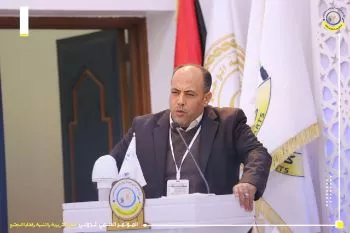
ABDUILAH ALMOKTAR ALMABRAK LABAD
Faculty head word
All praise is due to Allah, due praise to Him; He created humankind and taught them articulation. Peace and blessings be upon our noble Messenger, may Allah’s prayers and peace be upon him, and upon all those who follow him with righteousness until the Day of the Great Resurrection. To proceed:
Leadership and creativity do not arise from nothing; rather, they are the result of tireless effort exerted by individuals, using all the strength they possess, to attain the desired levels of excellence and mastery. Throughout its academic journey, which has exceeded twenty years, the Faculty of Arts at the University of Gharyan has remained a fountain of knowledge and culture for its students and staff alike. There has been no room for complacency or deficiency, regardless of how difficult or harsh the circumstances may have been. Distinguished scholars of language, literature, and the humanities—from both East and West—have taught at the Faculty, spreading knowledge and engaging deeply with its issues.
Its students receive the most advanced and up-to-date forms of knowledge, as a number of faculty members organize scientific seminars aimed at developing and updating curricular content in order to keep pace with the rapid global developments witnessed today.
With seriousness, diligence, determination, and the highest scientific and educational standards, faculty members adopt effective methodologies to benefit their students and equip them with valuable knowledge that serves the nation and contributes to its advancement.
Faculty members also participate in local and international conferences, and their contributions have become an important asset to the prestigious University of Gharyan.
Indeed, the steps toward success do not come from nothing; rather, they are built upon solid foundations and principles based on collective teamwork and effective partnership between the Faculty and research as well as governmental institutions within and beyond the surrounding municipalities. This ensures graduates who possess the necessary tools to solve the problems they face and those confronting their beloved homeland.
The Faculty strives, God willing, to obtain institutional academic accreditation, under the care and attention of Prof. Dr. Mohammed Ghouma, President of the University. Like the other faculties of the University, it is close to achieving program accreditation after fulfilling the required standards across various criteria. A scientific committee has been assigned—headed by the Director of the Quality Office and including a number of faculty members—to complete the accreditation of these programs.
In line with functional coordination among its units, departments, and the various university administrations and faculties, the Faculty encourages academic departments to develop and update their programs in accordance with university regulations. Furthermore, the Faculty intends to establish new departments in response to labor market needs.
And Allah is the Grantor of success in all goodness and righteousness.
Dr. Abdullah Al-Mukhtar Al-Labbad
Description
Following the issuance of the General People’s Committee for Education and Vocational Training Decision No. (787) of 1999, which stipulated the annexation of Al-Jabal Al-Gharbi University to the Seventh of April University in Zawiya, a subsequent decision was issued by the Assistant Secretary for Services, Decision No. (136) of 2000. This decision provided for the establishment of Universities of Faculties across the various Sha‘biyat (administrative regions) of Libya at that time. Among these was the Popular University of Gharyan.
Pursuant to this decision, the Department of History and Geography, the Department of Arabic Language and Islamic Studies, and the Department of Foreign Languages were established. The Departments of History and Geography and Foreign Languages were initially opened in the Maintenance Building in Gharyan, and were later relocated to the current faculty building in Al-Asaba‘a in 2001, where additional departments were inaugurated, namely the Departments of Tafsir (Qur’anic Interpretation), Psychology, and Sociology.
In 2003, the Faculty came to comprise a number of departments, including: Arabic Language, Islamic Studies, English Language, French Language, Geography, History, Philosophy, Psychology, Sociology, and Library and Information Science.
As the academic, educational, and research activities of the Faculty continued to develop steadily, postgraduate programs were introduced in several departments, namely: Islamic Studies, Arabic Language, History, and Psychology. Meanwhile, the Departments of Geography and Philosophy remain under establishment.
The Faculty of Arts in Al-Asaba‘a is determined, as part of its strategic plan, to open additional academic departments at both the undergraduate and postgraduate levels across various disciplines, whenever resources permit and in response to the requirements of the labor market.
Vision
The faculty seeks to achieve excellence, leadership and scientific excellence in the field of university education and scientific research, in addition to providing an academic climate that helps the student to learn and develop his culture that contributes to building society and knowledge by graduating qualified researchers and active leaders in society.
Mission
The faculty seeks to discover and disseminate science and knowledge in various branches of the humanities in addition to preparing those who are able to innovate and compete in the labor market to contribute to building a knowledge society capable of competing locally, regionally and globally, by upgrading the faculty's program and its various specializations in response to the diverse needs of society and the challenges of comprehensive development through pioneering scientific research that contributes to the development and service of society in accordance with the standards of academic preparation, and to benefit from this research in various fields of sustainable development.
Goals
One of the objectives of the faculty is continuous development and modernization, to meet the needs of society of specialized scientific cadres to keep pace with the scientific and technological progress witnessed by the contemporary world, by achieving the following:
1-Improving the level of effectiveness of the educational process, spreading the culture of quality and improving performance.
2- Developing academic programs and courses to meet the requirements of contemporary society.
3 -Supporting scientific research and preparing and qualifying researchers efficiently and distinctively.
4- Contribute to community service through research projects and advisory services that help develop education and solve community problems.
5-Commitment to excellence and modernity in providing courses, educational programs and scientific activities of high quality in the departments hosted by the college.
6-Continuous preparation and participation in programs and courses with the aim of refining skills and abilities and developing cumulative scientific experiences.
7- Encouraging and supporting researchers to produce a distinguished quality of scientific research and participate in scientific conferences and seminars at the local, regional and international levels.